Program Structure and Course Plan

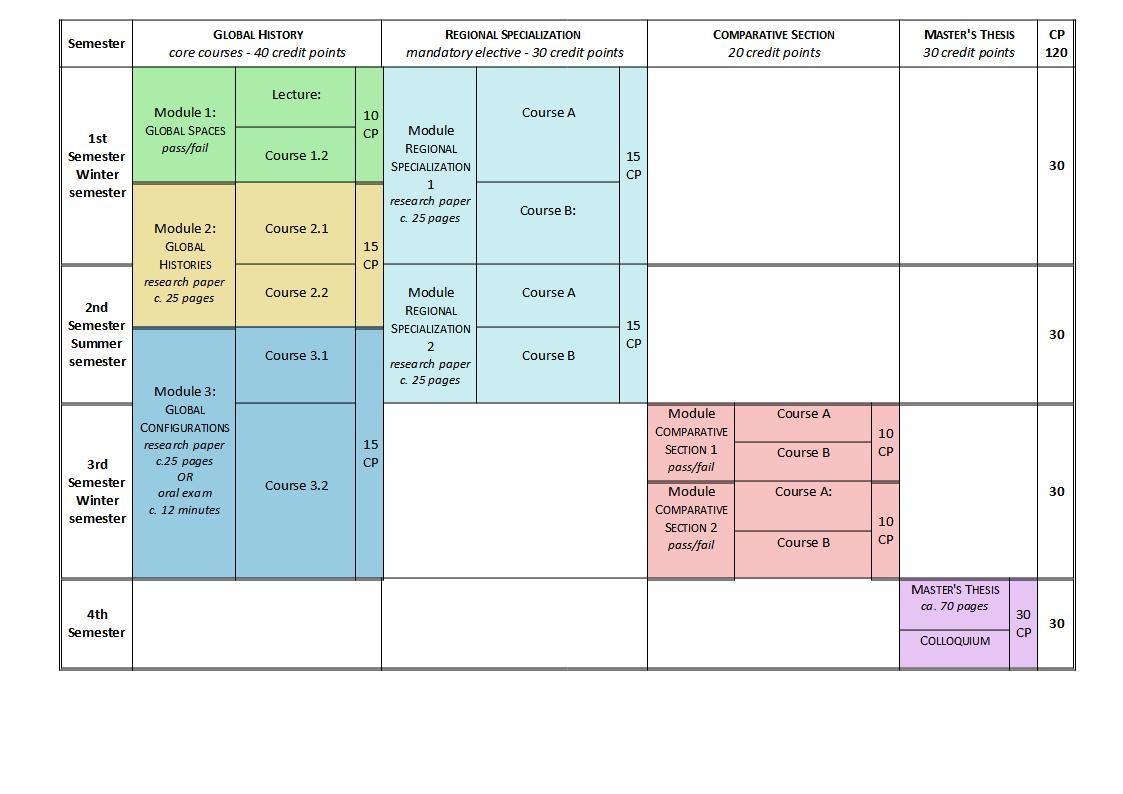
Course Plan Overview
REGULATIONS
2020 Study Examination Regulations (pdf-file)
2020 Study Examination Regulations German (pdf-file)
Old Course Plan (SPO 2012)
IMPORTANT NOTICE REGARDING MA THESIS: The regulations regarding the MA thesis are different from 2020. Physical copies do not need to be printed. Insetad: The MA thesis must be submitted as PDF (only) to the examination office of the ‘Geschichts- und Kulturwissenschaften’ Department via email the lastest 23:59 the day of you deadline as communicated by the examination office. Upon submission, you must state in writing that your thesis was independently written and that you have not made use of any unnamed sources or aid using the faculty’s declaration of independenceTERM PAPER GUIDELINES
If you are writing a term paper (Hausarbeit), we reccomend reading our program guidelines thoroughly, and referring back to them in future.
Important information for international students studying at FU/HU
Studying in Germany can be overwhelming at first, especially for international students.
While many students from different academic systems are used to a more structured learning environment, pursuing a degree in Germany requires careful planning and a high level of self-organization. The positive aspect is that students enjoy a significant degree of choice and flexibility, making effective planning essential.
Estimated Workload per Semester:
Students typically take between three to five seminars per semester, excluding lectures and language courses. On average, the reading load is around 40 to 70 pages per week per seminar. Additionally, there may be presentations or writing exercises throughout the term.
The average number of graded exams taken per semester is one.
Course organization:
The course plan is a recommendation for organizing classes within the two-year program and does not outline a mandatory sequence. Students can extend the time to complete their degree and may take modules in a different order.
For example, a student can begin a module and finish it two semesters later.
However, Module 1 is compulsory in the first semester. It is also strongly recommended to participate in the MA Colloquium after completing most of the coursework.
You may find the individual course plan form helpful to fill out when organising your studies
Program structure:
The MA program is divided into four main sections:
- GLOBAL HISTORY CORE COURSES (45 CREDIT POINTS):
This includes M1 (Global Histories), M2 (Global Spaces), and M3 (Global Configurations). Both M2 and M3 require a module exam, which can be either a graded term paper or, for M3, a graded oral exam.
2. SPECIALIZATION SECTION (40 CREDITS):
This includes M4 (Regions in Global History), M5 (Issues in Global History), and one elective module. M4 and M5 each require a graded term paper for their module exams. The elective module does not require a graded exam and offers options such as: - Taking a module focused on a specific historical epoch (M6, M7, M8, or M9). - Enrolling in a theoretical-methodological module (M11). - Completing an eight-week, full-time, unpaid internship during the semester break (M10) with an internship report.
3. INTERDISCIPLINARY ELECTIVE AREA (10 CREDITS):
Students must select a module from any other program at FU or HU. It is crucial to choose this module carefully, as requirements align with the relevant study and examination regulations; if an exam is part of the chosen module, it must be completed accordingly, and the grade will factor into the overall assessment.
Alternatively, students may take language classes.
For more details on the Interdisciplinary Elective Area, please visit:
4. MA COLLOQUIUM AND THESIS (30 CREDITS):
At the end of your studies, you will participate in the MA thesis colloquium (5 credits) and write your MA thesis (25 credits) under the guidance of two supervisors you select based on your topic and specialization.
Students can register for their MA thesis at any time, as there are no fixed registration dates.
Glossary of terms:
Modul: In general, two courses make up a module. For the most part, a module consists of a lecture (Vorlesung - VL) and a seminar (Seminar - SE). However, modules can also consist of advanced seminars (Hauptseminare – HS) and group work (Übungen – UE).
Seminar: In seminars (Seminare - SE) students and lecturers elaborate on a specific subject matter. During the seminars, students are expected to acquire basic academic knowledge and the methodology of academic work while dealing with selected topics.
Vorlesung: During a lecture (Vorlesung - VL), the classic teaching format at universities, a lecturer presents the subject matter, and students take notes and expand upon the topic through private study.
Übung: Group work (Übung - UE) gives students an opportunity to study in-depth the subject matter presented during lectures.
Hauptseminar: Advanced seminars (Hauptseminare - HS) are an introduction to working independently in an academic setting on a fairly broad subject for senior students.